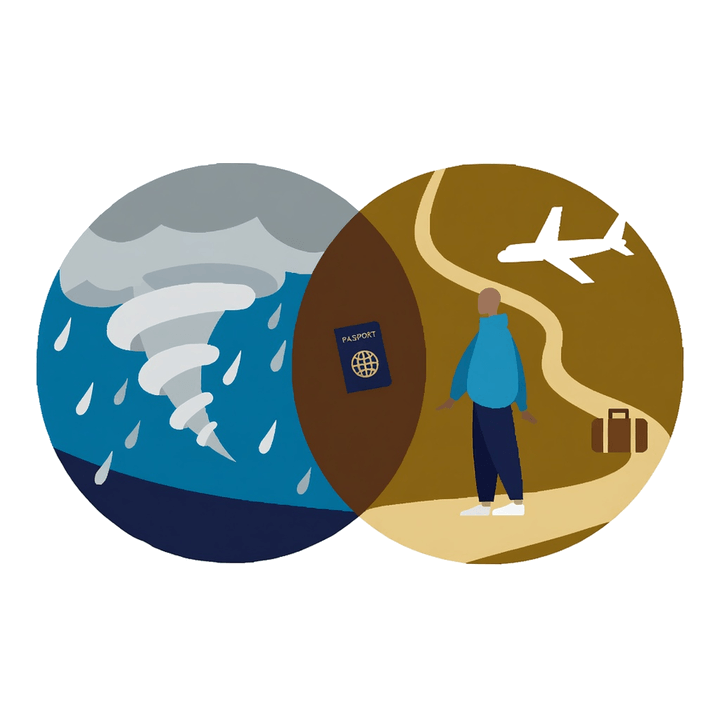
If you’re living with the threat of deportation, your body already knows what this is. It is trauma, and it starts costing you long before anything actually happens.
This piece is written for the person carrying the fear, not for a policy audience. If you want the wider clinical and systemic picture, the mental health effects of deportation covers that ground. What follows is about what the fear does to you, and what genuinely steadies it.
What the fear does to a mind and body
The threat of removal is a particular kind of stress: it has no end date and no off switch. A car accident ends. A diagnosis comes with a treatment plan. This one stays open, sometimes for years, and a nervous system responds to an open threat by staying ready for it.
Readiness looks ordinary from the outside. It looks like sleeping badly. Like checking the door. Like an unfamiliar number lighting up your screen and your stomach dropping before you have decided whether to answer. Like being short with the people you love most, because there is no attention left over for them. Over months it settles into anxiety, low mood, trouble concentrating, and the sort of hypervigilance that makes it hard to be present with the very people you’re trying to protect.
That’s what a nervous system does when the danger is real and open ended. Trauma is the accurate word for it, and having the accurate word matters, because a person who believes they are overreacting spends their energy arguing with themselves instead of taking care of themselves.
You are not fragile. You are living braced, and bracing is expensive.
What I notice most often in a first session is the apology. People arrive and begin by explaining why their fear is reasonable, as though I might disagree, or by naming someone who has it worse so they can put themselves second. I have stopped treating that as a detour. It tells me how long a person has been managing their own reaction on top of managing the actual situation, and setting down that second job is usually where the work starts.
Why a mixed status household carries its own arithmetic
Mixed-status households are common, not unusual. The Urban Institute’s most recent count of children of immigrants found roughly a quarter of them, about 4.7 million children, are US citizens living with parents who are not citizens, and in families where a parent is undocumented, about two thirds of the children are US born. In practice that means a single household can hold a citizen child, a green card holder, someone waiting on a case, and someone with no status at all, all sitting down to the same dinner.
That produces a daily arithmetic people outside it rarely see. Which parent does the school pickup. Whether to answer an unknown number. Whether to file the complaint against the landlord. How much to tell the children. Who would collect them, how quickly, and with what paperwork, if the worst arrived on an ordinary Tuesday morning.
Running that math is exhausting on its own, separate from any enforcement event ever occurring. If you’re the person in your family who runs it, the fatigue you feel is the cost of a job nobody trained you for and nobody is paying you to do.
What your children are absorbing

Children read the temperature of a home far more accurately than adults expect. Research on families affected by immigration enforcement from the Migration Policy Institute and the Urban Institute found that children whose parent was detained or deported frequently became depressed, and that the depression showed up in their bodies and their schoolwork: changes in eating and sleeping, anxiety, sadness, anger, and withdrawal, alongside falling grades. Children who were present at the moment a parent was taken tended to carry the heaviest emotional and behavioral effects.
There is also a quieter presentation worth knowing about, because it’s easy to mistake for a child coping well. Clinicians in Sweden have documented a condition they call resignation syndrome among asylum seeking and refugee children living under the threat of removal: a loss of interest in things the child used to love, withdrawal from people, a drop in physical activity, and in the most severe cases a child who becomes emotionally unresponsive to what is going on around them. Almost no child goes anywhere near that end of it. What matters at home is simpler. Distress in a child doesn’t always look like crying; sometimes it looks like a kid who has gone quiet and stopped asking for anything.
| What you might see | What it can mean | What tends to steady it |
|---|---|---|
| Clinging, tantrums, new fears at bedtime | The child senses the change and has no words for it | Predictable routines and plain reassurance about today |
| Stomachaches, headaches, appetite changes | Anxiety showing up in the body before it reaches language | A calm visit to the pediatrician, then naming the worry out loud at home |
| Grades slipping, refusing to go to school | Fear about what will be waiting at home when the day ends | One trusted adult at the school who knows enough to watch out for them |
| Going quiet, losing interest, giving no trouble at all | Shutdown, which is distress rather than adjustment | Gentle, direct questions, and a therapist if it doesn’t lift |
You’re allowed to tell them something true. Things are hard right now. The adults are working on it. You’re loved, and you’re safe with me today. A child who is handed a silence they can feel but can’t understand will fill it with something worse than the truth.
Five things that actually help

None of these fix the underlying situation, and pretending otherwise would be insulting. They keep the fear from running the whole show, and a steadier version of you makes better decisions, works better with an attorney, and holds a household together more effectively than an exhausted one.
1. Put the plan on paper
Uncertainty is fuel for anxiety, and a mind fills a blank with the worst available version. A written family preparedness plan turns swirling dread into a set of known steps. Most plans cover the same ground: who to call first, where the identity and immigration documents live and who can reach them, who is authorized to collect the children and what that person needs in writing, which relative or friend can hold money for the household, and the name and number of an immigration attorney.
The legal parts belong to a licensed immigration attorney, never to a therapist. The reason I raise the plan in a mental health context at all is that people sleep differently the week after they finish writing it. A plan gives the nervous system something solid to hold.
2. Shrink the timeframe you’re living in
The fear wants you living in every possible future at once, and every one of those futures is bad. Pulling your attention back to the next hour, the next task, the next meal often gets called denial, when it works far more like triage. You handle the hour in front of you, because the hour in front of you is the only one you can affect.
When a spiral starts, interrupt it in the body instead of arguing with it in your head. Name five things you can see, four you can hear, three you can feel against your skin. Then move: stand up, drink water, step outside for two minutes. It sounds far too small to matter, and real time is the only place a spiral can actually be caught.
3. Protect sleep like it’s medicine
Chronic fear wrecks sleep, and lost sleep makes fear louder, harder to reason with, and quicker to tip into panic. That loop is worth fighting on purpose. A consistent wind down, a hard stop on news and group chats an hour before bed, a dark and quiet room, and a phone that charges somewhere other than your pillow are small levers, and they move the version of you that wakes up to handle the case.
4. Tell one person the true version
Isolation multiplies this kind of stress, and secrecy is tiring in its own right. You don’t have to disclose your status to anyone unsafe. You do need at least one person, a friend, a cousin, a faith community, a clinician, who knows the actual weight you’re carrying and doesn’t need it explained from the beginning every time.
If you’re the one everybody else leans on, this is the step you will quietly skip. Please don’t skip it.
5. Say the true thing to your children, at their size
Age appropriate honesty is a skill, and it gets easier with practice. A five year old needs to know who picks them up and that they are safe tonight. A ten year old can hold that a lawyer is working on something for the family. An older child already knows more than you think and will handle a straight answer far better than a locked door.
Answer the question they asked, not the one you’re afraid of. Say what is being done. Say who is safe. Say when you don’t know something, then say what you will do next.
Tonight
Put the phone outside the bedroom and get one real night of sleep. Everything else is easier from there.
This week
Write the plan, even a rough one. Tell the people named in it that they are named in it.
This month
Book time with an immigration attorney about your actual case, so your fear is working with facts.
Keep going
One person who knows the true version. One routine that holds. One hour at a time when the day gets loud.
Where the legal track and the emotional track meet
Some situations call for a formal psychological evaluation as part of a case: asylum, an extreme hardship waiver, or a VAWA self petition. That’s distinct work from therapy. An evaluation is a clinical interview plus testing that produces a written report documenting psychological history and current functioning for a court or for USCIS, on a defined timeline. The immigration evaluation page explains how that process runs, and the VAWA psychological evaluation page covers that specific petition in more detail.
An evaluation doesn’t replace support, and support doesn’t replace an attorney. People do best when the legal, the practical, and the emotional parts are each held by someone whose actual job that is.
When should you reach for support?

Consider talking to someone if the fear has stopped visiting your days and started running them.
None of those mean you’re failing; they mean the load is heavy enough to deserve a second set of hands.
Therapy for this doesn’t pretend the threat is imaginary, and any clinician who tries to talk you out of your fear has misread the situation. The work goes to the part that lives inside you: the sleeplessness, the hypervigilance, the frozen feeling, the guilt, the grief for a life you built that somebody else gets to vote on. Depending on what a person needs, that might draw on cognitive behavioral therapy, acceptance and commitment therapy, internal family systems, or attachment based work. The holistic mental health support page explains how I work, and the psychotherapist in Maryland page covers care for adults across Maryland and Washington DC by secure telehealth.
Cost is a real barrier and pretending otherwise helps nobody. This practice is self pay and doesn’t bill insurance, though a superbill is available if your plan offers out of network reimbursement. The self pay mental health services page lays that out honestly, and the sliding scale therapy in Washington DC page explains the lower cost route and how its waitlist works.
A word to hold onto
Fear that never switches off is one of the heaviest things a person can carry, and carrying it badly on some days says nothing about you except that you’re responding sanely to a genuinely frightening situation, with a nervous system that’s doing exactly what it was built to do.
You may never get control over the outcome, and you can still build a little steadiness inside the waiting, without having to build it by yourself. If all you manage this week is one written plan, one honest conversation, and three decent nights of sleep, that counts. That’s exactly where this work starts.