



A healing journey for the in-between
Island Mind,
Foreign Ground
For everyone who left one world and never fully arrived in the next, who still dreams in one language and lives in another, who has stopped trying to explain the ache to people who’ve never felt it. This is a place for that grief to finally land.

Maybe you never fully arrived
Maybe you left your home country and some part of you is still standing at that airport gate, watching it get smaller. Maybe you were born here, but your house smelled like somewhere else, and you learned early how to be two different people before you even understood why. Maybe you’ve gotten so good at code-switching that you sometimes catch yourself mid-sentence and can’t remember which version of you is the real one.
The guilt for leaving. The grief for a place that raised you and then had to let you go, and doesn’t quite recognize you anymore either. It’s real. It has a name. And it deserves more than a shrug and a “well, that’s just how it is.”
Order your copy
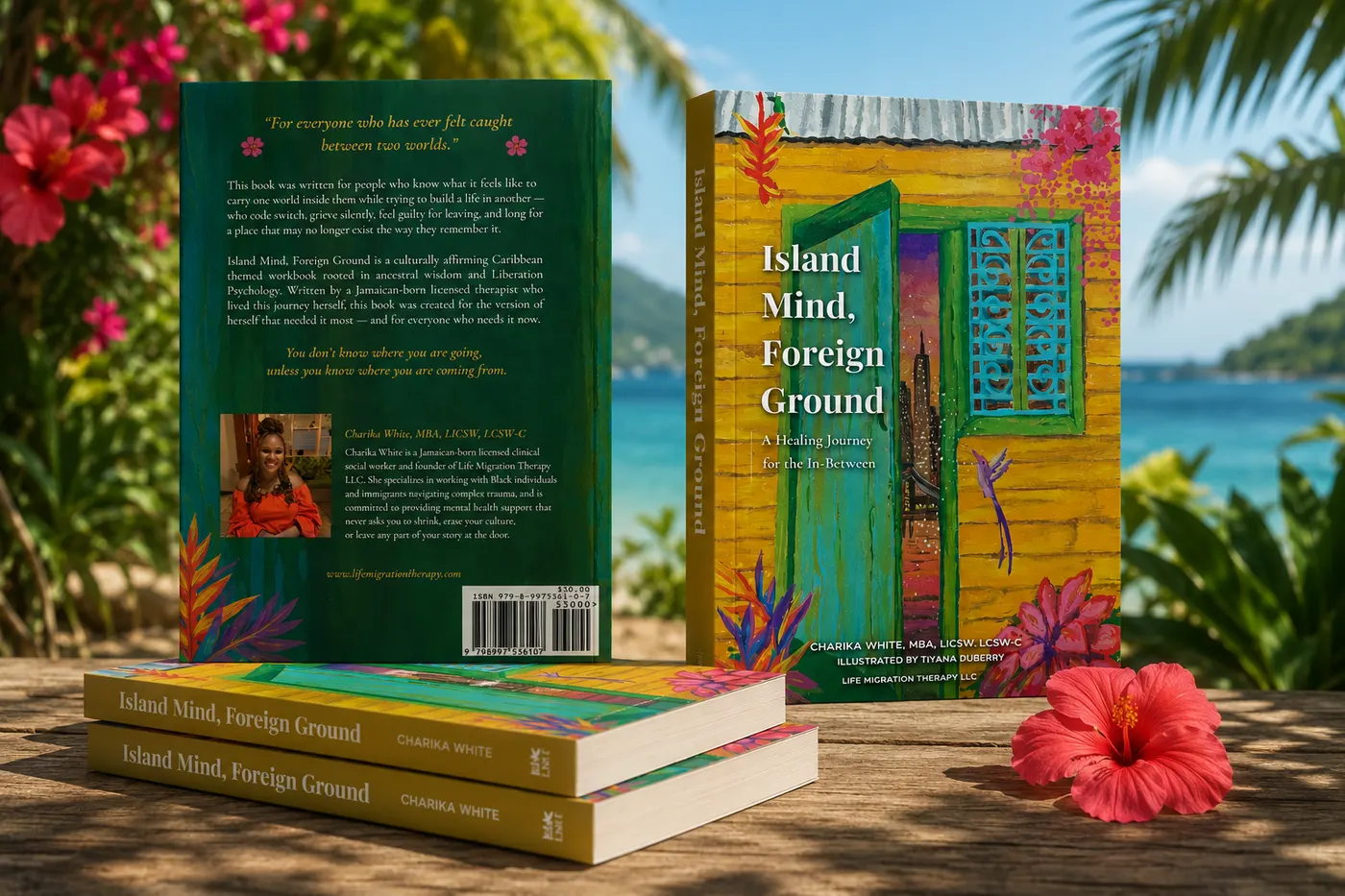
A physical workbook, made to be written in, with Tiyana Duberry's artwork carried through every section.

Out now
Island Mind, Foreign Ground
A workbook rooted in Caribbean culture and wisdom, for the nights you’re wide awake missing a place you also had to leave. Six sections of honest, substantive exercises that walk you through where you’ve been, what it cost you to get here, and where you’re going next. Written by a Jamaican-born licensed psychotherapist who has cried through these same pages herself, not just studied them.
- Six guided sections with real exercises
- 80 pages
- Physical book, made to be written in
- Ships October 2026
Read the first 6 pages, free.
Out now. Your copy is printed to order and shipped to you.
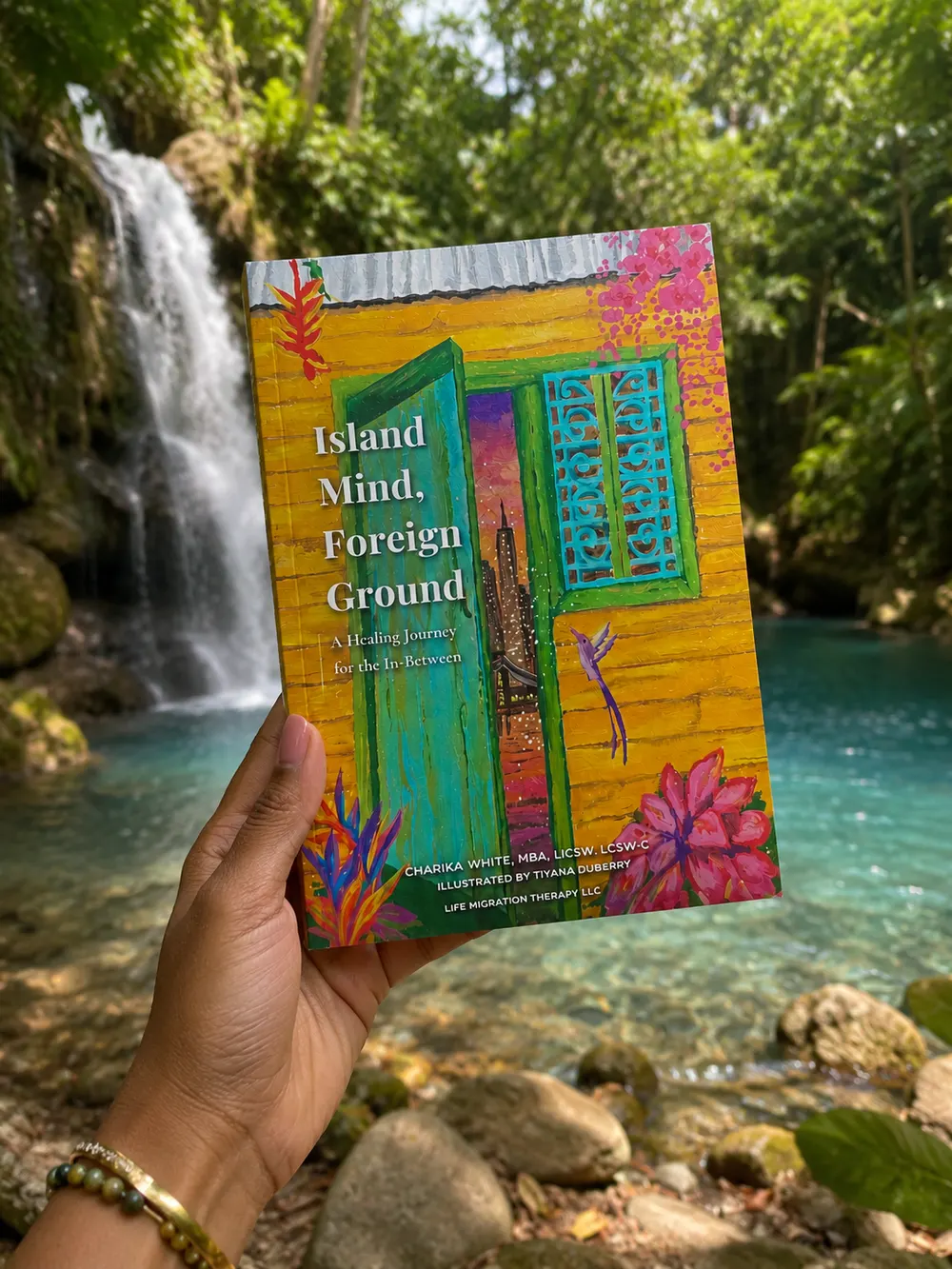
Colorful, vibrant and a reminder of home.
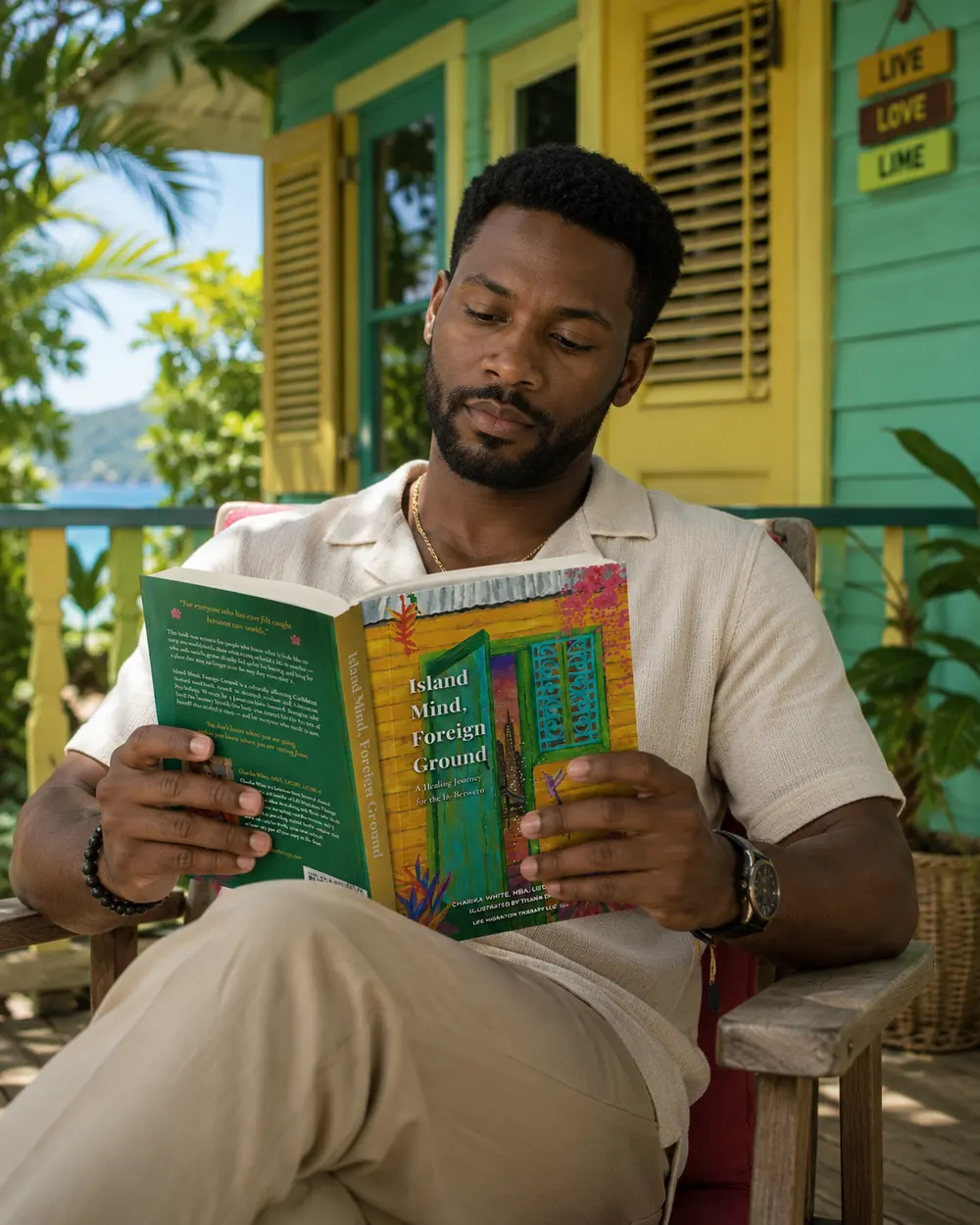
It’s a workbook, so bring a pen to it. Write in the margins, dog-ear the pages you want to come back to, and leave it open wherever you left off.
Guilt, shame, nostalgia, grief.
It’s the guilt that shows up when you’re laughing too freely at a birthday party while someone back home is struggling, and you have to excuse yourself for a minute. It’s calling your grandmother and hearing your own accent flatten out, your Patois gone stiff, like a language you’re now translating instead of one you used to live inside of. It’s the shame of not knowing the name of the storm that flooded your cousin’s street, because you found out three days late, scrolling. It’s mourning a homeland that’s changed without you, and grieving a version of yourself, the one who still belonged there without having to explain it, who doesn’t exist anymore either.
The hardest part is that almost nowhere was built to hold this. You bring it up and get a blank look, or worse, a “well, at least you’re here now.” Therapy wasn’t designed with people who look like us in mind, and there aren’t enough people who can sit with what it actually feels like to be stuck in the in-between, how it shows up in the mirror, in your relationships, in the way you can’t quite rest even when there’s finally nothing to run from. Island Mind, Foreign Ground was built to be that space. The one that doesn’t flinch, doesn’t rush you, and doesn’t need the whole thing explained first.
Island Mind, Foreign Ground was created to be that space.
Six sections, and real work in each one.
You don’t have to do this in order, or all at once. Some days you’ll be ready for Rooted, and the smell of your grandmother’s kitchen. Other days you’ll only get through one page of The Crossing before you have to set the book down and breathe. Both are the work. Nobody’s timing this but you.
One · Rooted
Where you come from, the smell of fried plantain on a Sunday morning, the sound of your mother’s voice going up an octave on the phone with her sister, the way your people turned hardship into a joke at the dinner table because that was its own kind of medicine. They passed all of it down without ever once calling it a gift. This section helps you finally call it one.
Two · The Crossing
The leaving itself, the suitcase that could only hold so much, the goodbye at the gate that you told yourself wasn’t really goodbye, the version of you that got left on the tarmac and never got picked back up. Nobody ever thought to count what the journey cost you, including you.
Three · Family Ties
The people you left behind on the phone bill and the remittance app. The people you brought, who sometimes look at you like you’re a stranger wearing their child’s face. The ones born here, who love the island through your stories instead of the soil. Obligation, distance, and love that has to travel further than love was ever built to go.
Four · Faith and Belonging
What you were raised to believe, in church, in ancestral stories whispered after the lights went out, in your grandmother’s certainty that God was watching. What you kept, what you quietly let go of somewhere over the Atlantic, and where you put your fear and your hope now that the old altar isn’t in reach.
Five · Who I Was, Who I Am
The versions of you the move required, the one who softened her accent for the job interview, the one who got quiet at family gatherings back home because she didn’t sound like herself anymore either. Which of these you chose. Which ones you were never really given a choice about. And which ones you’re finally ready to stop performing. There is a free code-switching quiz if you want a number for that part first.
Six · The Space Between
The space between islands and highways, between the accent you grew up with and the one you’ve adopted, between who they raised and who you had to become to survive here. Not a waiting room you’re supposed to rush through on your way to somewhere else, a real place, worth understanding, because it turns out you’ve been living in it the whole time.
Every section opens with a cultural proverb, then a coloring page, then plain-language writing about what is happening and why, then reflection prompts, exercises, and a closing affirmation. Roots & Rhythms notes run throughout, holding the traditions and celebrations our communities carry.
What is migration trauma?
Migration trauma is the weight you’ve been carrying so long you forgot to notice it was ever put on your back, the grief, the guilt, the quiet rearranging of yourself the move demanded before you were even old enough to consent to it. It is not a diagnosis, and you are not the only one. It is the honest response of a person to something that happened to an entire people, and it is allowed to still hurt.
You are not broken, and you are not being dramatic. What you’re carrying has a shape and a history, it didn’t begin with you, and it was never yours to untangle alone. A scholar named Ignacio Martín-Baró spent his life showing exactly that: what colonization and displacement do to a people does not stay abstract. It moves into bodies. It moves into families. It moves into the quiet moments you doubt yourself and can’t say why.
Immigrant guilt is one of its most common shapes: the sense of having done something wrong by leaving, or by doing well after you left. It sits next to survivor guilt and what some people call thriver’s guilt, the discomfort of building a good life when the people you left never got the same chance. Children of immigrants carry their own version, first generation and second.
It shows up in small, specific moments, not as one big feeling, but as a hundred quiet ones:
- Guilt for the people who stayed, and the ones who sold what they had so you wouldn’t have to.
- Guilt for missing the funerals, the birthdays, the slow unremarkable Sundays you’ll never get back.
- Guilt for hearing your own accent thin out, for reaching for a word in Patois and finding English there instead.
- Guilt for resting, when rest was never something the people before you were allowed.
- Guilt for grieving a place you chose to leave, as if choosing it should have made the loss smaller.
Migratory grief is the other half of it, and it’s rarely one loss at a time. That is part of why it goes unnamed for so long: there is no single thing to point at, so it gets carried instead of spoken about. If you want the clinical reading of why this material is so often mishandled, the piece on decolonizing therapy goes further, and the rest of the therapy resources library is free to read.
Written by someone who has lived it.
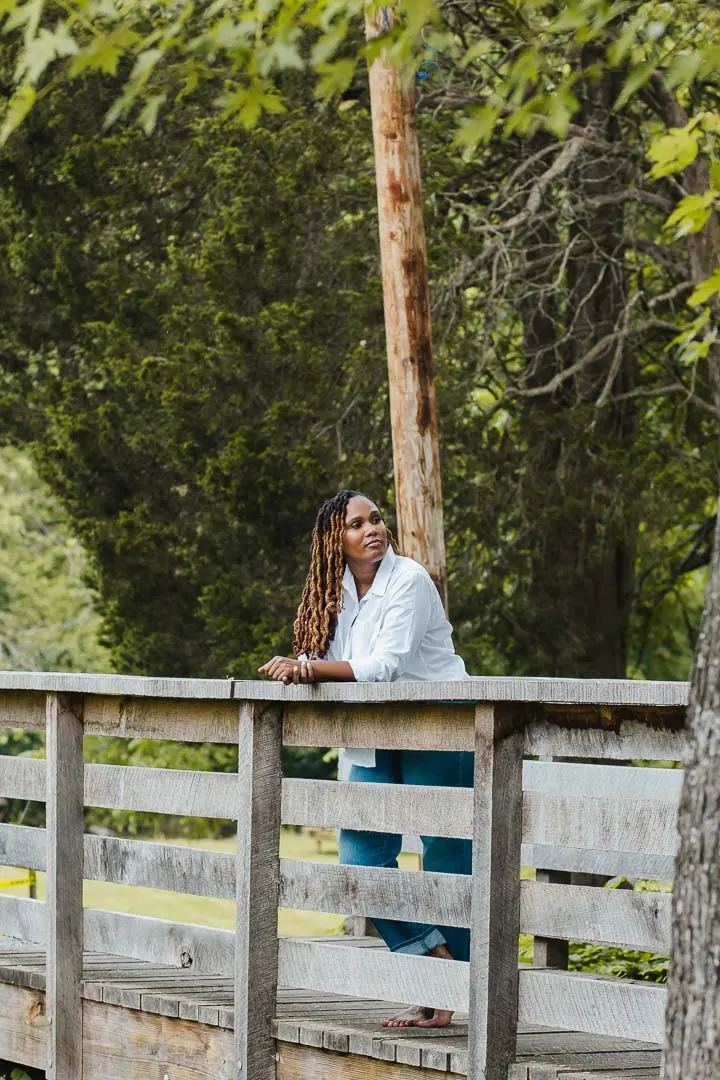
Charika White is a Jamaican born licensed psychotherapist, an LICSW in Washington DC and an LCSW-C in Maryland. She wrote this book from both sides of the desk. She has spent years in her own therapy working through the exact grief this workbook is built to hold, long before she ever helped a client through it. This isn’t theory to her, it’s lived experience.
Her clinical practice sits alongside the book. She works with adults across Maryland and Washington DC on exactly the material the workbook opens up, and she writes about it at length in pieces on breaking generational trauma and Jamaican resilience and mental health.
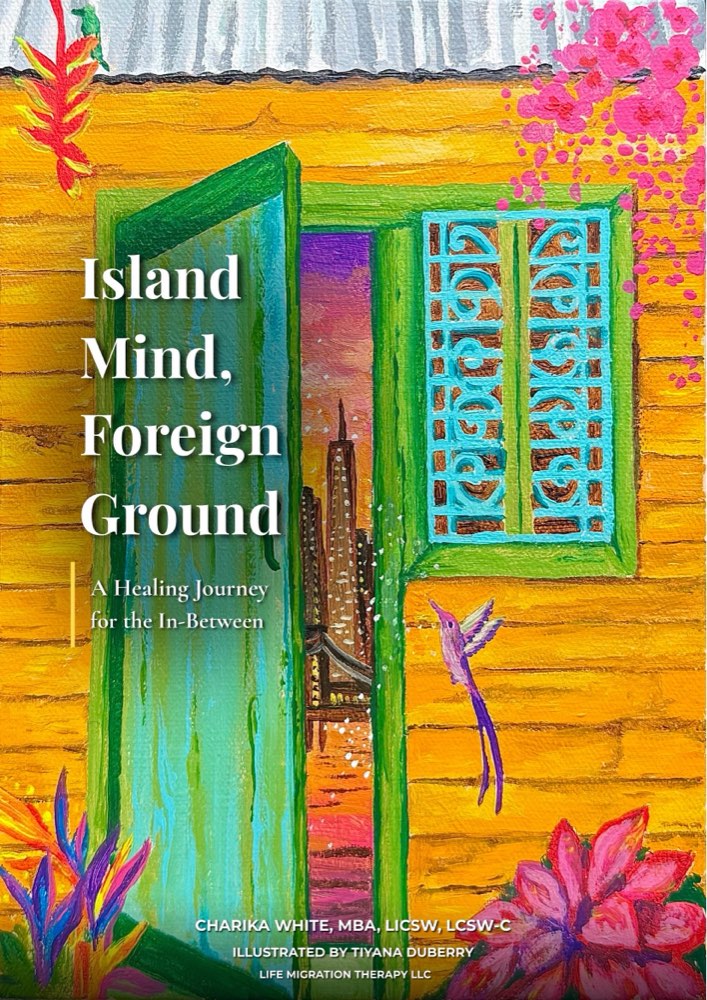
The workbook is illustrated by Tiyana Duberry. She painted it in the visual energy the material deserves. These books usually get a muted palette, and this one doesn’t. The cover is her work: a yellow house with the door standing open onto a skyline that isn’t home yet.
Meet Tiyana Duberry, the illustrator and artist.

Tiyana Duberry is an artist whose artistry is rooted in the visual language of West Indian culture (Trinidad and Montserrat) and the lived experiences of the Black diaspora. Her work explores identity, heritage, and storytelling through the use of vibrant colour, intricate patterning, and layered symbolism.
Drawing from her personal narrative and upbringing, she infuses each piece with authenticity and emotional resonance. Her work creates compositions that honour cultural memory while celebrating the richness of the Black experience.
Through her art, Tiyana aims to create space for reflection, connection, and cultural affirmation, inviting viewers into a world shaped by history, emotion, and bold visual expression.
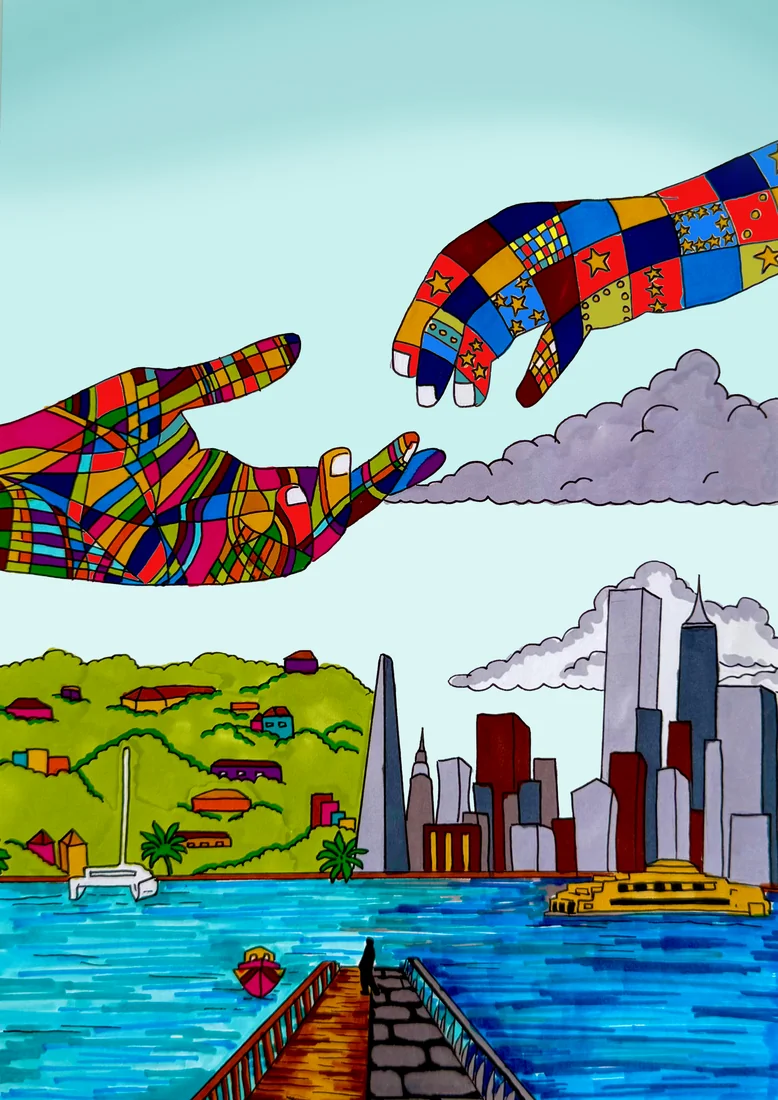
Her artwork is carried through every section of the book.
Questions about the book.
What is Island Mind, Foreign Ground about?
Island Mind, Foreign Ground is a reflective healing workbook for people who live between two worlds. It makes room for migration grief, the guilt of leaving people behind, the exhaustion of switching versions of yourself depending on the room, and the complicated love for a place that shaped you and also hurt you. It’s written for Caribbean diaspora and immigrant communities, and the themes reach anyone who left one country for another or grew up in a household that belonged somewhere else.
Who is this workbook for?
Adults in the Caribbean diaspora, first and second generation immigrants, and anyone raised in a home that belonged to another country. You don’t need to be in therapy to use it, and you don’t need a diagnosis. If you’ve ever felt that no space was built to hold what living in the in-between actually feels like, it was written with you in mind.
Who wrote it?
Charika White, a Jamaican born licensed psychotherapist. She’s licensed as an LICSW in Washington DC and an LCSW-C in Maryland, and she runs Life Migration Therapy. She understands this experience clinically and personally, and she’s been in her own therapy for years because of these same themes.
Is this a substitute for therapy?
No. It’s a reflective workbook, not treatment, and it doesn’t replace working with a licensed clinician. Some people use it on their own, some bring what surfaces into their existing therapy, and some read it and decide they want support alongside it. If you’re looking for that support in Washington DC or Maryland, you can reach Charika directly through the practice.
What makes it different from other healing workbooks?
Most weren’t built for this. Therapy as a field wasn’t designed with people who look like us in mind, and there aren’t enough clinicians who can name what the in-between actually feels like. This workbook is rooted in Caribbean culture and wisdom, so it speaks the language of the people it was written for, and it draws on ways of healing that existed in our culture long before therapy had a name.
What is migration trauma?
Migration trauma is the lasting weight of leaving one place for another: the grief, the guilt, and the quiet rearranging of yourself the move asked for. It is not a diagnosis and it is not rare. A scholar named Ignacio Martin-Baro spent his life showing how things done to whole communities, being colonized, displaced, or made to feel less than, end up living inside each person as pain, confusion and grief. Immigrant guilt and migratory grief are two of the shapes it takes.
What is immigrant guilt?
Immigrant guilt is the sense of having done something wrong by leaving, or by doing well after you left. It shows up as guilt for the people still back home, for missing funerals and birthdays and slow ordinary days, for speaking the language less well than you used to, and for building a life that the people who sacrificed for you can’t share. It isn’t a diagnosis. It’s a common and largely unspoken part of migration, and naming it is usually the first thing that makes it lighter.
Does immigrant guilt ever go away?
Immigrant guilt usually softens instead of disappearing, and that’s a fair outcome to aim for. What tends to change is the grip: you stop treating the guilt as evidence that you owe someone a debt you can never pay, and start treating it as a signal of how much the people and the place still matter to you. The workbook has exercises for exactly that shift, and some people work through them alongside therapy, not in place of it.
What are the four stages of migration trauma?
Migration is usually described in four stages: pre-migration, transit, resettlement, and acculturation. Each one carries its own stress, and the later two are where most people are living by the time they go looking for words for any of it. That’s a framework from the wider migration literature rather than a Life Migration Therapy model, and the workbook treats it as a map for what you’re already carrying, not as a schedule you’re behind on.
How much does the book cost and when can I buy it?
The workbook is $25 plus shipping, and it is out now as a physical book. You can order it on this page, and you will get an email the moment your copy ships.
Will there be an ebook?
Not at launch. It’s being released as a physical workbook first, which is a deliberate choice given how the exercises are meant to be worked through by hand.
Hear what comes next.
Add your email for news about the book and what Charika writes next. Nothing else in between.
This is the first workbook of its kind written by and for Caribbean diaspora and immigrant communities on migration trauma. If that’s a book you’ve been waiting for, this is how you hear about what comes next.
Prefer to skip the form? Book your free call directly or call or text 301-244-8219.
Somewhere to land softly.
Somewhere between the island you left and the ground you’re standing on now, there’s a place to finally set this down, even just for the length of one page.
Join the list for the book, or if you’d rather talk to someone now, the first conversation with Charika costs nothing.