If you have ever left a session feeling like something was missing, like the person across from you did not quite get you, you’re not imagining it.
Maybe you watched a therapist’s face change when you mentioned your grandmother’s remedies. Maybe you felt yourself flatten your voice, trim the story, translate your family into terms that would land in the room. Maybe you decided halfway through the hour that some things were simply not worth explaining.
There’s a real cost to all of that, and it’s the reason this work exists.
What does decolonizing therapy mean?
Decolonizing therapy examines how colonization and systemic oppression shaped mental health care itself, removes the parts of that inheritance that harm and diminish people of color, and puts back what the field never treated as valuable in the first place. Your heritage, your spiritual life, your language, the obligations you carry, the way your community has always handled grief: all of it becomes material for the work, not background noise to get past.
The phrase reached most clinicians through the work of Dr. Jennifer Mullan, whose book Decolonizing Therapy pushed the argument into professional conversation. The thinking is older than that. Frantz Fanon, a psychiatrist from Martinique, wrote in Black Skin, White Masks in 1952 about what colonization does to the mind of the colonized, and about a psychiatry that kept diagnosing individuals while leaving the conditions producing their distress entirely untouched.
Put plainly, decolonizing therapy asks a question most training never raises: who decided what healthy looks like, and what did they leave out?
It removes
Diagnostic habits and treatment defaults that read a normal response to an abnormal situation as a disorder inside the person having it.
It restores
Ancestral knowledge, spiritual practice, community, and your own account of what wellness means, all of which the literature treated as folklore.
How it relates to culturally responsive care
These two ideas get used interchangeably, and they are close kin, but they work at different levels.
| Culturally responsive practice | Decolonizing practice | |
|---|---|---|
| The question it asks | Does my practice adapt to the person in front of me? | Where did this model come from, and whose norms did it install as normal? |
| Where the change happens | In how a method gets delivered | In which methods get treated as authoritative at all |
| What it does with your culture | Accounts for it | Draws on it as part of the treatment |
| What it does with power | Notices it | Names it out loud in the room and works to keep it from shaping the hour |
Most clinicians who take one seriously end up practicing both. If the first is what you’re looking for, cultural responsiveness covers that ground in depth. This piece stays with the second.
The history worth understanding

Psychology was not built with us in mind, and the record is specific about it.
In a 2008 review published by the American Psychological Association, Jeffrey Arnett found that 96 percent of the samples in the field’s most prominent journals came from Western industrialized countries, which hold roughly 12 percent of the world’s population. A discipline that studied one eighth of humanity went on to describe what it found as human nature.
Before that there was worse. In 1851 Samuel Cartwright published a diagnosis he called drapetomania, a supposed mental illness that caused enslaved people to run away. The reasoning is a clean example of the pattern: the desire for freedom got located inside the person as a defect, and the system producing the desire went unexamined.
That logic did not disappear when the label did. It got subtler.
The APA itself named this. In 2021 its Council of Representatives issued a formal apology for the organization’s role in perpetuating racism and human hierarchy in the discipline.
Meanwhile, training rolled forward. Students enter graduate programs and learn theories built by predominantly white faculty studying predominantly white samples, and the syllabus rarely contains a word about ancestral knowledge or the practices communities have used for generations. The gap shapes care to this day: the clinical mechanics of treatment get taught thoroughly, while the cultural context that determines how a person understands suffering in the first place gets skipped.
Four assumptions came baked into the inheritance, and they are worth naming individually, because each one produces a specific misreading.
The individual is the unit of health
Western models locate wellness inside a separate self. Many cultures locate it in the condition of a set of relationships. Geert Hofstede's research on individualism and collectivism mapped that gap decades ago, and the therapy room still assumes one side of it.
The nuclear family is the frame
Two parents and their children. Grandmothers raising grandchildren, aunties with real authority, godparents, chosen family, and households split across two countries all register as irregular against that frame; normal was never on the table for them.
Talking to a stranger is the mechanism
Verbal disclosure to an unrelated professional is one culture's healing technology among many. Elsewhere the work has always happened through ritual, movement, food, music, prayer, or a long conversation with an elder.
The secular position is the neutral one
A framework that treats spiritual experience as, at best, a coping style has quietly excluded the thing that organizes many people's entire understanding of suffering, meaning, and repair.
What gets misread when the frame is wrong
A response that makes complete sense in your family can look like a symptom in a manual.
Grief. Extended mourning, a Nine Night, anniversaries observed for decades, speaking to and about the dead, dreams understood as visits. Set against a manual that expects grief to resolve on a schedule, all of that can get flagged as complicated or prolonged. The DSM added a Cultural Formulation Interview in 2013 in part because clinicians were making exactly this error, though a tool in the back of a book only helps the clinicians who open it.
Spiritual life. Prayer as a first response. A sense that a relative who has passed is still present and still commenting. Traditions a clinician may never have encountered. Screened through a secular default, these get treated as avoidance at best and as something to assess at worst, and most people learn to leave them out of the room before anyone has to say so.
Family and community obligation. This is the one I see misread most often. The money you send home every month. The calls you take at midnight because it’s morning where they are. The decision you don’t make without your mother. The cousin sleeping in your living room. Inside a curriculum built on individuation, all of that reads as enmeshment, poor boundaries, or codependency, and the standard intervention is some version of putting yourself first, which asks you to solve the problem by withdrawing from the people who are also holding you up.
A decolonizing stance holds both halves at once. Obligation can be genuinely crushing and genuinely load-bearing in the same family, often in the same week. The work is sorting out which is which, not prescribing distance by default.
Anger. Rage at a system is a proportionate response to that system. Treated as a symptom to be reduced, it stops being information and starts being a target, and the person carrying it learns that the room can’t hold it either.
What it looks like in a real session

Instead of rushing toward a diagnosis, I spend the early sessions getting to know you and where you come from, what you have lived through, and what you already know about how you heal. I’m honest about the power in the room, because I would rather name it than let it operate quietly.
We build the path together. In most training the clinician is positioned as the expert who knows what is best for you. Here you bring your narratives, your knowledge, and your strengths, and the plan gets made out of those. Your experiences with racism, your family’s migration, the specific things that shaped you, are the foundation we build from.
More than one way of knowing is allowed in. Maybe your grandmother’s remedies made more sense to you than any diagnosis ever has. Maybe your faith or your connection to your ancestors steadies you more reliably than any coping skill I could teach. That belongs in the plan.
Power gets named. There is a real imbalance in a clinical relationship. I hold credentials and you came looking for support, and race makes those dynamics more complicated rather than less. We acknowledge it, talk about it when it’s live, and keep it from bending the relationship out of shape.
The habit I find myself naming most often is translation. People arrive fluent in clinical English for their own lives: they say enmeshment when they mean Sunday dinners, boundaries when they mean a mother who calls twice a day, and then, quietly, “I know how this sounds” right before the part that matters most, the dream, the visit from someone who has passed, the sense that something was handed down. I would much rather hear that part in the first month than in the third year.
The traditions the field left out

Long before psychotherapy existed, communities had well-developed ways of handling exactly what therapy now handles. Collective mourning that kept a grieving person surrounded for days. Storytelling that carried the history and the lesson at the same time. Elders whose authority came from having lived it. Ritual that marked a passage so the change felt real. Music, movement, food, prayer, the long walk with an aunt. None of it entered the literature as treatment; it got called folklore, and clients absorbed the message.
Restoring it doesn’t mean I perform your tradition or claim authority over it. What it means is that I ask what a practice does for you, treat it as a resource you already have, and build a plan that works alongside it. Working around it defeats the purpose.
It also means being honest about where the leverage actually sits. Sometimes the most useful item in a plan has nothing to do with the hour we spend together: the aunt you stopped calling, the church you stopped attending, the language you stopped speaking at home, the food you stopped cooking because it took too long. Isolation is often the injury, and a weekly session is a thin substitute for a community you already belong to.
What this means for immigrants and children of immigrants

For people who migrated, and for the generation raised by them, a few patterns come up so often they are worth naming directly.
The hierarchy of suffering
There is a specific shame in struggling when your parents survived so much more. What you're carrying gets measured against a border crossing, a war, a decade of separation, and it always loses the comparison, so you stop mentioning it. Both things can be true. Their survival was extraordinary and yours is still hard.
Growing up as the interpreter
The nine year old translating at the clinic, the bank, the parent teacher meeting. That child learned to manage adult information and adult fear early, and the competence they built is real. So is the cost, and it usually surfaces much later as a difficulty being anything other than the responsible one.
Being a line in the family budget
Remittances are not discretionary spending. When a therapist treats them as a boundary issue and not as a fixed obligation with real meaning, the conversation ends there.
Two selves, and neither fully at home
One version of you at home, another outside it. Too foreign in one room, too assimilated in the other, and fluent in the loneliness that sits between them.
Grief for a place
No manual lists mourning a country, a climate, a street, a version of yourself that only existed there. It behaves like grief because it's grief.
Legal fear as a clinical fact
For a lot of families this is not abstract anxiety but an accurate read of a real situation, and it belongs in the room as such. If your immigration matter also calls for a formal evaluation, immigration evaluations are a separate service with its own process.
Finding a therapist who works this way
You don’t need the right vocabulary to start. If any of this named something you have felt in a previous therapy room, that’s already useful information about what to look for next.
A few questions sort it out quickly:
- What communities have you actually worked with, and what did that work look like?
- How do you handle spiritual or cultural material a client brings in?
- Are you comfortable naming race and power inside the room?
- What happens if I tell you something that sounds unusual to you?
A therapist doesn’t have to share your background to do this well, and shared background alone guarantees nothing. What matters is whether they have done the work of examining their own training. How someone answers those questions tells you more than any directory badge, and you’re allowed to ask before you book.
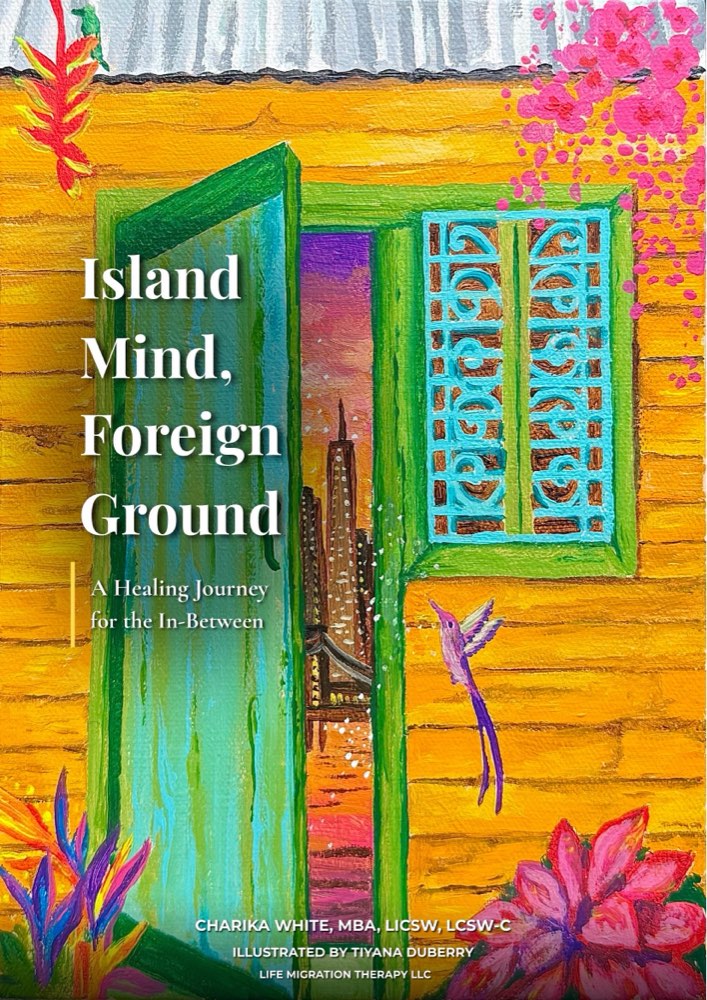
If you want to see how it runs here, holistic mental health support covers my background and approach, individual therapy in Maryland covers how sessions actually work week to week, and the pages on finding a Black female therapist in DC or an African American therapist in Maryland cover what identity-matched care looks like in each place. The practice is self-pay, and the self-pay therapy page explains that openly, including the superbill for possible out-of-network reimbursement. And if you want to work through this material on your own first, Island Mind, Foreign Ground is the workbook I wrote for the Caribbean diaspora.
You should never have to choose between being fully yourself and getting good care.