I can still remember being excited as a child when we heard a hurricane was coming. We were entirely uninterested in the warnings, in the rebuilding that would follow, or in the real danger of it. Through a child’s eyes we thought about being out of school. About our parents being home for days on end. About snacks, and baths in the rainwater caught during the heaviest rain, and going outside to play in it.
When the eye of the storm brought that strange calm, we would go out and see what had happened while our parents kept us tucked safely away. Those are some of my fondest memories of growing up in Jamaica.
As a child you can see a natural disaster as a chance for the family to come together, to feel safe and surrounded by love, and to eat really good food that your parents usually did not have time to make because they were working and commuting. Mine was one of those childhoods.
The two realities inside one storm
There was another reality, though, for classmates who did not have secure housing, or the money to stock up on food and supplies before the storm. Even as a child I felt for them. As an adult I have come to see the disparities inside my own country more clearly. The economic and emotional weight of extreme weather lands on vulnerable communities differently, and it always has.
And still, I can’t help but appreciate that generationally we were taught to tap into collective joy during the hardest moments of our lives. For many of us the hardest moments arrived with the storms.
What outsiders miss about Caribbean resilience
People assume that because we live on an island, we all want to leave it. They assume that because we know hardship, we must not love our country or our culture. They find it puzzling to watch Jamaicans on social media enjoying themselves in the middle of a hurricane.
Outsiders read that as recklessness. Look at it through an anti-oppressive lens and something else comes into view: we were taught, from slavery onward, how to make the most of uncertainty and catastrophe. We are genuinely good at this. It’s mental health support passed down through generations, long before any of it had clinical language attached to it.
Community care is the heart of it
We are also very good at community care. Checking in on loved ones. Riding out a storm with music. Lending a neighbor a cup of flour, some rice, some sugar. Helping clear the debris, helping repaint after the water recedes, cooking a meal and sharing it out. That’s the heart of Jamaica, and the heart of my people.
Living through Hurricane Melissa, I kept returning to the same thought. My island can be in the middle of real catastrophe and the soul of who we are still rings true. Us rising above it. Us getting more involved in community, more intentional about staying connected. When a disaster plan gets activated, Jamaicans prepare their homes, their hearts, and their bonds.
Out of many, one people is not only a motto. It is a mental health strategy.
Caribbean stress management is a real skill set
These practices are the ones many mental health professionals are only now beginning to understand and fold into their work. What an outsider might read as denial is a sophisticated way of holding steady under ongoing threat, and it deserves to be treated as a skill set, not a symptom.
When I work with Caribbean clients, part of my job is reading the coping correctly before touching it. What looks like avoidance is frequently boundary setting by someone who learned early that not every fire is yours to run into. What seems like resistance is frequently self preservation, built by people who had good reason to be careful about who they handed themselves to. And joy in the middle of pain is a deliberate choice and not denial, a refusal to let circumstances take everything at once.
Caribbean stress management therapy, done well, starts from those strengths instead of dismantling them. It builds on the community check in, the music, the food, the faith, the humor, and the instinct to get practical fast. Then it adds what the inherited toolkit tends to leave out, which is rest, grief, and permission to stop.
Where resilience meets its limits
I want to hold what comes next with equal weight, because it’s what gets lost when resilience becomes a compliment instead of a description.
Being good at surviving is not the same as being fine.
Climate anxiety is a growing concern, especially for people from communities that face crisis after crisis. Extreme weather now threatens not only physical safety but the emotional experience of living in constant anticipation of the next disaster. Collective joy is real, and it isn’t a substitute for rest, for grief, or for care when the weight becomes too much to carry alone.
A culture can be extraordinarily resilient and still contain people who are exhausted, with no contradiction between the two. The pressure to be strong, to be the one who holds it together, can itself make it harder to admit when you’re not okay. If you grew up being praised for how well you cope, asking for support can feel like a betrayal of that identity.
A great many people arrive burnt out from being the strong one. They are the person the whole family calls, the one who sends money, the one who translates, the one who handles the hospital and the paperwork and the funeral arrangements from four hours ahead in another time zone.
Nobody has asked them how they are doing in years, including themselves.
There is a specific version of this that many Caribbean and diaspora clients name once they feel safe enough to say it. Mental health carried real stigma in the world they grew up in, and seeking therapy could be read as weakness, or as airing family business to a stranger. Those messages don’t vanish because you moved or grew up. They sit quietly in the background of a first session, and part of the work is giving yourself permission to override them. Choosing support is not a rejection of where you come from; for someone raised on resilience it can be one of the most self respecting things they ever do.
What you may be carrying all at once
Building a life here
The present tense stress of work, housing, money, paperwork, and starting over in a place that did not make room for you in advance.
Worrying about home
Family in the path of the next storm, and the particular helplessness of loving people through a phone line and a weather map.
Inherited weight
The intergenerational trauma of colonialism and everything after it, which arrives in a family long before anyone has words for it.
Code switching all day
The daily exhaustion of adjusting your voice, your hair, your name, and your reactions to be legible in rooms not built with you in mind.
Any one of those is a full load. Most people I sit with are carrying all four and calling it a normal week. Some of that weight also travels down a family line, which is the subject of a separate piece on breaking generational trauma in immigrant families.
When the news breaks and you’re thousands of miles away
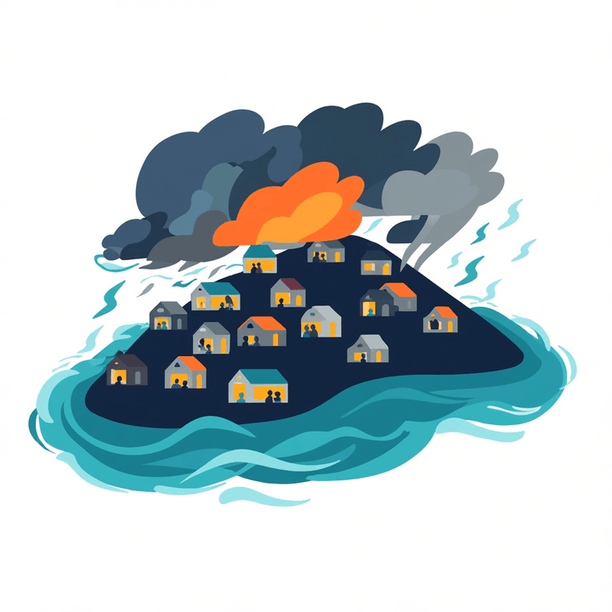
There is a grief specific to watching your homeland get hit while you’re somewhere else entirely. When Hurricane Melissa struck, Caribbean immigrants across Maryland and Washington DC felt a resurgence of anxiety, grief, and helplessness that many had not expected. Some described survivor’s guilt: a house still standing here, a job still running, groceries in the fridge, while cousins waited days for a roof and a road.
Others carried something clinically recognizable as post traumatic stress, triggered by the coverage itself. The looped footage, the aerial shots of flattened zinc, the photographs of a street you know by name. A nervous system that stored one storm as a child doesn’t distinguish neatly between a memory and a livestream, so the body reacts as though it’s happening to you right now, in your kitchen, six hours before work.
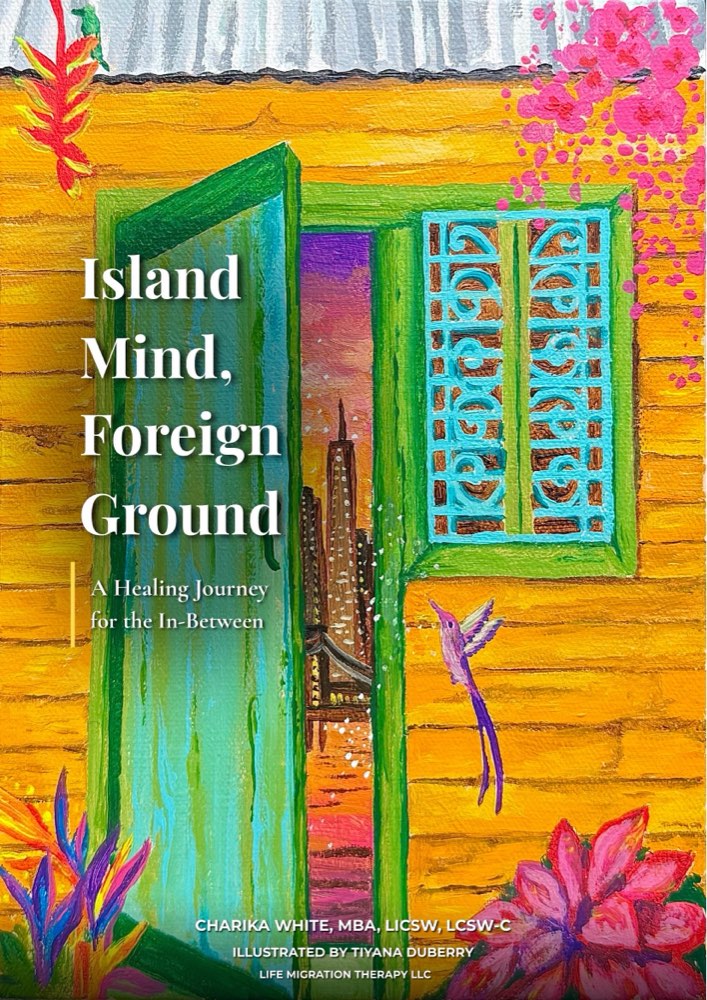
For people whose migration story also runs through a legal case, that layer sits on top of everything above. The trauma of facing deportation piece covers the fear directly, and the immigration evaluation page explains the formal psychological evaluation work used in asylum, hardship, and VAWA petitions. For the reflective version of this material, I wrote Island Mind, Foreign Ground, a workbook for the Caribbean diaspora.
Telling depression or anxiety apart from tiredness
Low mood in someone raised to keep moving rarely announces itself as sadness. It shows up as irritability, as a shorter fuse with the people you love, as taking on more work because stopping feels dangerous, as a body that aches without a clear reason, as sleep that either won’t come or won’t end.
Some honest markers that this has moved past ordinary tiredness: the low feeling has not lifted in weeks even when something good happens, you have withdrawn from the people and the music and the food that usually restore you, you’re drinking more to get the edge off, or you’re getting through each day on an autopilot you can’t switch off.
Depression and anxiety counseling for Caribbean residents and immigrants works best when it holds all of that context at once. Structured approaches adapt well here: cognitive behavioral therapy in Washington DC gives you something concrete to do with a spiraling thought, and acceptance and commitment therapy is useful when the situation itself can’t be changed and the question becomes how to live well alongside it.
Community care and collective healing
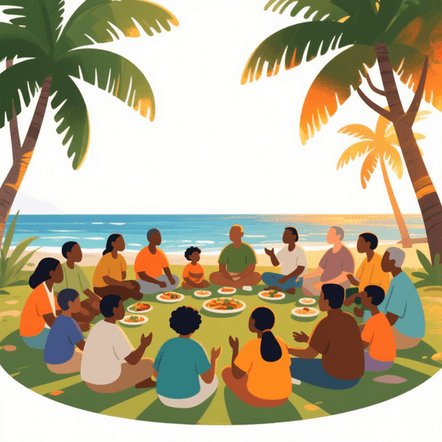
The Jamaican approach to a storm is fundamentally communal. We don’t prepare alone, weather it alone, or rebuild alone. That instinct is worth protecting after migration, because it’s one of the first things a move quietly takes from you.
A long research literature on perceived social support points the same way: people who believe there are others they can rely on fare measurably better against depression and anxiety than people who feel they are on their own. Notice that it turns on the belief as much as the headcount. Ten acquaintances and no one you would call at two in the morning is a thin support system, however busy your calendar looks.
Do you need a Jamaican therapist to feel understood?
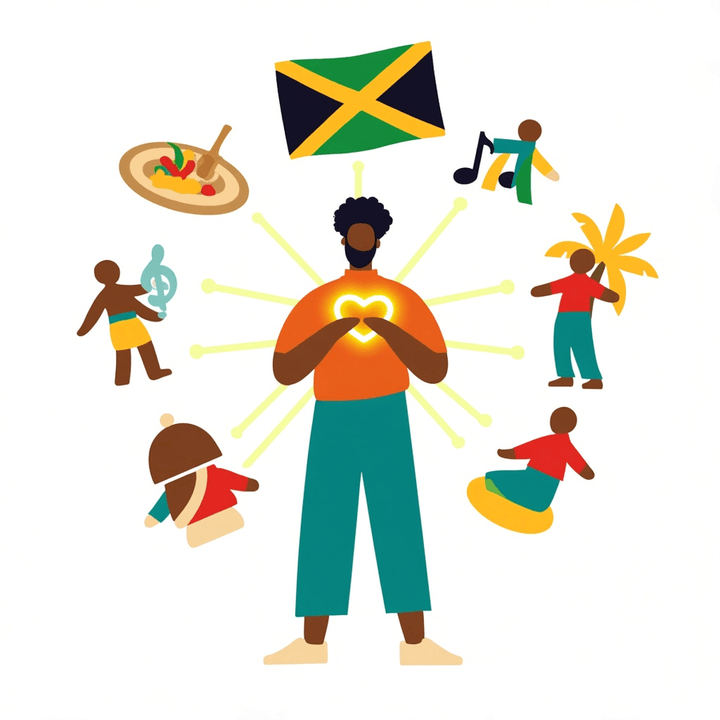
You don’t need one, though you do need a clinician who treats your culture as context, not as a curiosity, and for a lot of people a Jamaican therapist or a therapist from the wider diaspora is simply the shortest route to that.
I grew up in a house where you managed. So when someone tells me, usually about forty minutes into a first session, that they have never said any of this out loud before, I’m not surprised and I don’t need it explained. I know what it costs to be the reliable one. I know the particular shame that can come with struggling when your parents survived so much more, and I know how quickly that shame turns into silence.
I bring this history into the room on purpose. When a client from the Caribbean or the wider diaspora sits with me, I try to steer around the two readings that miss it: resilience as a problem to be dismantled, and resilience as evidence that support is unnecessary.
The resilience is real and it's a resource. You're still allowed to be tired.
If your story runs through migration, two cultures, and a family that taught you to make the most of hard things, that background isn’t something you have to explain from scratch here. My holistic mental health support page covers how I work. The African American therapist in Maryland and Black female therapist in DC pages speak to the identity side of this care, the psychotherapist in Maryland page covers ongoing individual therapy for adults by secure telehealth, and decolonizing therapy explains the wider frame I work from.
Out of the storm
Caribbean resilience has carried our people through slavery, colonialism, economic exploitation, and storm after storm. It should not also require you to carry everything by yourself, or to pretend you’re never frightened or worn through.
The same cultural practices that helped you survive can be adapted to help you live well. Seeking therapy extends that inheritance instead of betraying it, and the practical side is straightforward: the self pay mental health services page explains how sessions and superbills work, so cost is a known quantity before you ever sit down.
Out of the storm, we learned to hold each other. You’re allowed to be held too.